
What Cynthia is working on now
Since 2014 she has led aging research at Calico, the Alphabet-founded company devoted to the biology of aging. Wikipedia ↗
What Cynthia has done
- 1993
Found that mutations in one gene, daf-2, make the worm C. elegans live more than twice as long, and that this needs a second gene, daf-16: the largest lifespan extension then reported in any organism (Nature). Nature, 1993 ↗
- 1999
Co-founded Elixir Pharmaceuticals with Leonard Guarente to find drugs that slow aging. Wikipedia ↗
- 2014
Joined Calico full time. Her lab had by then extended worm lifespan as much as sixfold by changing the insulin/IGF-1 pathway. Wikipedia ↗
Videos by and about Cynthia

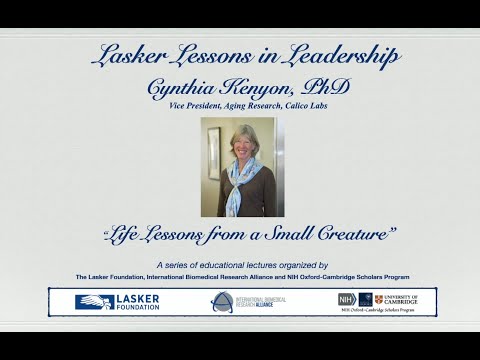 Talk · 58 minCynthia Kenyon: Lasker Lessons in Leadership March 30, 2021Albert and Mary Lasker Foundation · Apr 3, 2021"Life lessons from a small creature": the discovery and her career since.
 Interview · 2 minCan we delay ageing?FT Life · May 16, 2017A short Financial Times film on the research that suggests aging can be slowed.
Titles, channels and dates are YouTube's own, checked on YouTube. We link to these videos; we don't make or endorse them. A video that stops playing is taken off this page automatically.
Also in why we age
- Linda PartridgeWeldon Professor of Biometry, University College London; founding director emeritus, Max Planck Institute for Biology of AgeingShowing that rapamycin and nutrient-sensing genes extend lifespan in flies; co-author of the Hallmarks of Aging3 videos
- Carlos López-OtínDepartment of Biochemistry and Molecular Biology, University of OviedoLead author of The Hallmarks of Aging, the most cited map of how aging works1 video
- Vera GorbunovaDoris Johns Cherry Professor of Biology and Medicine, University of RochesterFinding why naked mole rats and bowhead whales resist cancer and live so long, and moving it into mice3 videos
- Leonard GuarenteNovartis Professor of Biology, Massachusetts Institute of TechnologySirtuins: the genes that tie diet, NAD+ and aging together in yeast and worms1 video
- Elizabeth BlackburnProfessor emerita, University of California, San Francisco; former president of the Salk InstituteCo-discovering telomerase, the enzyme that rebuilds chromosome ends; Nobel Prize, 20092 videos


